Al-Fatiha, "The Opening", is the first surah of the Quran and the one Muslims recite most: at least seventeen times a day in the five daily prayers. It is a complete prayer in itself: it begins by praising Allah, declares that we worship Him alone, and ends by asking Him for guidance.
It has seven verses. In the recitation most commonly taught (Hafs), "Bismillah" counts as the first verse.
Verse 1: Bismillah
بِسْمِ ٱللَّهِ ٱلرَّحْمَٰنِ ٱلرَّحِيمِ
TransliterationBismillahir-Rahmanir-Rahim
MeaningIn the name of Allah, the Most Gracious, the Most Merciful.
We begin by asking for Allah's help and blessing through His names Ar-Rahman and Ar-Rahim, both from the word for mercy.
Surah Al-Fatiha 1:1
Verse 2: Alhamdulillah
ٱلْحَمْدُ لِلَّهِ رَبِّ ٱلْعَٰلَمِينَ
TransliterationAlhamdu lillahi Rabbil-'alamin
MeaningAll praise is for Allah, Lord of all the worlds.
"The worlds" means everything that exists apart from Allah: people, jinn, angels and all of creation.
Surah Al-Fatiha 1:2
Verse 3: Ar-Rahman Ar-Rahim
ٱلرَّحْمَٰنِ ٱلرَّحِيمِ
TransliterationAr-Rahmanir-Rahim
MeaningThe Most Gracious, the Most Merciful.
Right after calling Allah the Lord of the worlds, the surah reminds us that His lordship is full of mercy.
Surah Al-Fatiha 1:3
Verse 4: Maliki yawmid-din
مَٰلِكِ يَوْمِ ٱلدِّينِ
TransliterationMaliki yawmid-din
MeaningMaster of the Day of Judgement.
Mercy is balanced with accountability: every person will meet Allah and answer for their deeds.
Surah Al-Fatiha 1:4
Verse 5: Iyyaka na'budu
إِيَّاكَ نَعْبُدُ وَإِيَّاكَ نَسْتَعِينُ
TransliterationIyyaka na'budu wa iyyaka nasta'in
MeaningYou alone we worship, and You alone we ask for help.
The heart of the surah. Putting "You" first in the Arabic gives the meaning "You alone", ruling out worship of anything else.
Surah Al-Fatiha 1:5
Verse 6: Ihdinas-siratal-mustaqim
ٱهْدِنَا ٱلصِّرَٰطَ ٱلْمُسْتَقِيمَ
TransliterationIhdinas-siratal-mustaqim
MeaningGuide us along the straight path.
The most important request a person can make, which is why we repeat it in every rakah.
Surah Al-Fatiha 1:6
Verse 7: Siratal-ladhina an'amta 'alayhim
صِرَٰطَ ٱلَّذِينَ أَنْعَمْتَ عَلَيْهِمْ غَيْرِ ٱلْمَغْضُوبِ عَلَيْهِمْ وَلَا ٱلضَّآلِّينَ
TransliterationSiratal-ladhina an'amta 'alayhim, ghayril-maghdubi 'alayhim wa lad-dallin
MeaningThe path of those You have blessed, not of those who have earned Your anger, nor of those who have gone astray.
After this verse we say "Amin", meaning "O Allah, answer". The Prophet ﷺ said whoever's Amin coincides with the Amin of the angels is forgiven his past sins (Sahih al-Bukhari 780).
Surah Al-Fatiha 1:7
Virtues of Surah Al-Fatiha
- The greatest surah of the Quran. The Prophet ﷺ told Abu Sa'id ibn al-Mu'alla that Al-Fatiha is the greatest surah, "the seven oft-repeated verses and the Great Quran" (Sahih al-Bukhari 4474).
- No prayer is complete without it. "There is no prayer for the one who does not recite the Opening of the Book" (Sahih al-Bukhari 756).
- A conversation with Allah. In a hadith qudsi, Allah says He has divided the prayer between Himself and His servant, and answers each verse as it is recited: "My servant has praised Me", "My servant has glorified Me", and for the final verses, "This is for My servant, and My servant shall have what he asked for" (Sahih Muslim 395).
Other names of Al-Fatiha
It is also called Umm al-Kitab (the Mother of the Book), As-Sab' al-Mathani (the Seven Oft-Repeated Verses, Surah Al-Hijr 15:87), Al-Hamd (the Praise) and Ash-Shifa' (the Cure).
Reciting Al-Fatiha correctly
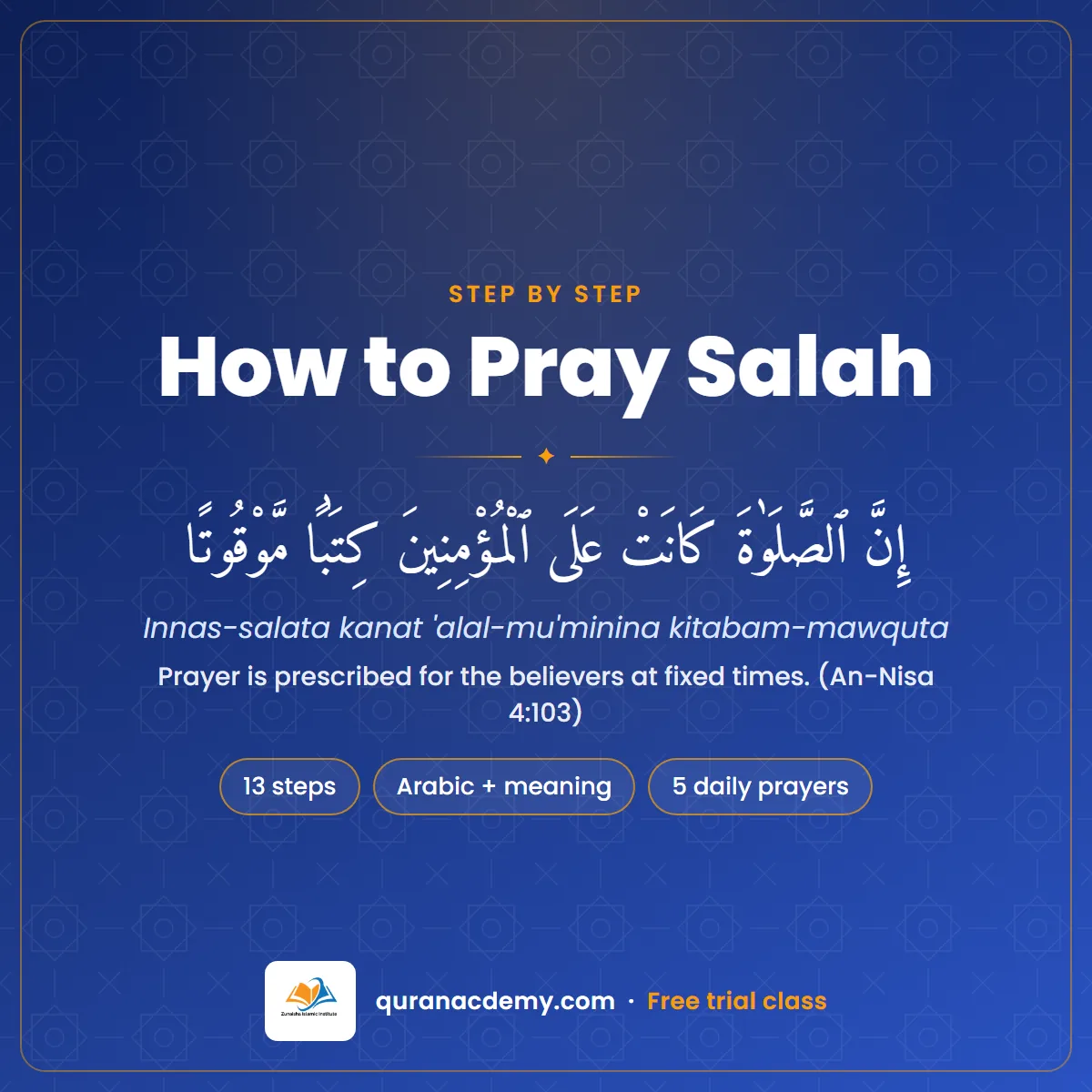
Because Al-Fatiha is part of every prayer, its pronunciation matters more than any other surah. Some letters change the meaning if they are confused: for example al-‘alamin (the worlds) must begin with the letter ‘ayn, and the dad in wa lad-dallin is a sound that does not exist in English. Our online Tajweed course starts with exactly this, and children can learn it in our Quran classes for kids. Next, learn how to pray salah step by step.
Frequently asked questions
How many verses are in Surah Al-Fatiha?
Seven. In the Hafs recitation used in most Mushafs, Bismillah is counted as the first verse.
Why is Al-Fatiha recited in every rakah?
The Prophet ﷺ said there is no prayer for the one who does not recite it (Sahih al-Bukhari 756), so it is recited in every rakah of every prayer.
What is the meaning of Surah Al-Fatiha?
It praises Allah as the merciful Lord of all the worlds and Master of the Day of Judgement, declares that we worship and ask help from Him alone, and asks Him to guide us on the straight path of those He has blessed.
Is Bismillah part of Surah Al-Fatiha?
In the Hafs recitation and according to the Shafi'i school, yes, it is the first verse. Other scholars count it as a separate verse placed before the surah. Either way, it is recited before Al-Fatiha.
How long does it take to memorize Surah Al-Fatiha?
Most children learn it in one to two weeks, and adults often in a few days. Getting the pronunciation right with a teacher may take a little longer, and it is worth it.
Last updated 29 October 2026. Spotted a mistake? Let us know.