The six Kalimas are short declarations of faith that Muslim children have learned by heart for generations, especially in Pakistan, India, Bangladesh and the UK. Each one teaches a core belief: that Allah is One, that Muhammad ﷺ is His Messenger, that Allah deserves all praise, and that we should turn back to Him and keep away from shirk.
The six are not listed together in one hadith. Scholars put them together as a teaching aid, using wording that comes from the Quran and hadith. The first Kalima, though, is the heart of Islam itself, and its two parts make up the Shahadah that every Muslim says.
1st Kalima: Tayyib (Purity)
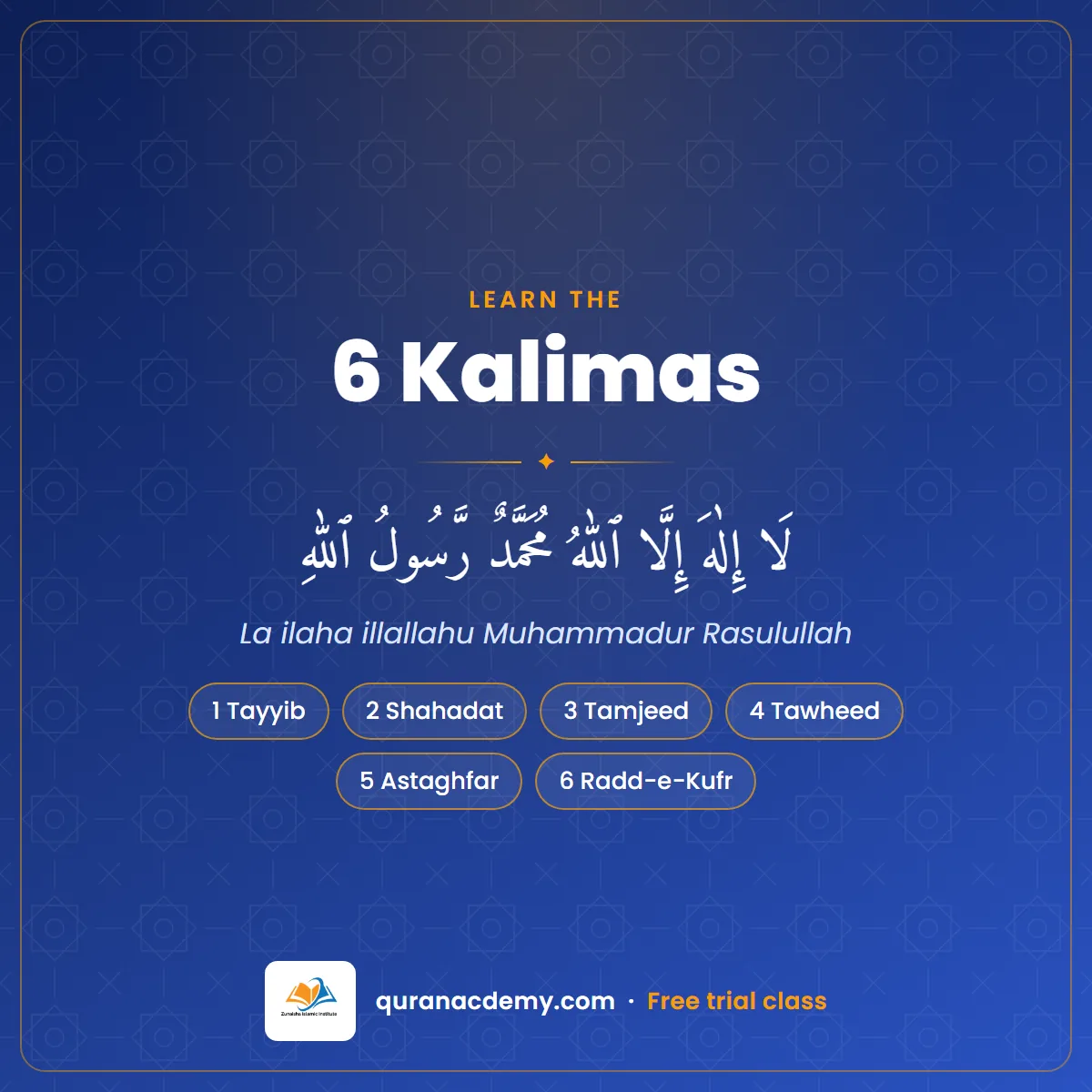
لَا إِلٰهَ إِلَّا ٱللّٰهُ مُحَمَّدٌ رَّسُولُ ٱللّٰهِ
TransliterationLa ilaha illallahu Muhammadur Rasulullah
MeaningThere is no god but Allah. Muhammad is the Messenger of Allah.
Both parts appear in the Quran: Surah Muhammad 47:19 and Surah Al-Fath 48:29
2nd Kalima: Shahadat (Testimony)
أَشْهَدُ أَنْ لَّا إِلٰهَ إِلَّا ٱللّٰهُ وَحْدَهُ لَا شَرِيْكَ لَهُ وَأَشْهَدُ أَنَّ مُحَمَّدًا عَبْدُهُ وَرَسُوْلُهُ
TransliterationAshhadu an la ilaha illallahu wahdahu la sharika lahu, wa ashhadu anna Muhammadan 'abduhu wa rasuluh
MeaningI bear witness that there is no god but Allah. He is One and has no partner. And I bear witness that Muhammad is His servant and His Messenger.
Wording of the tashahhud and the testimony after wudu: Sahih Muslim 234
3rd Kalima: Tamjeed (Glorification)
سُبْحَانَ ٱللّٰهِ وَٱلْحَمْدُ لِلّٰهِ وَلَا إِلٰهَ إِلَّا ٱللّٰهُ وَٱللّٰهُ أَكْبَرُ وَلَا حَوْلَ وَلَا قُوَّةَ إِلَّا بِٱللّٰهِ ٱلْعَلِيِّ ٱلْعَظِيْمِ
TransliterationSubhanallahi wal-hamdu lillahi wa la ilaha illallahu wallahu akbar, wa la hawla wa la quwwata illa billahil-'aliyyil-'azim
MeaningGlory be to Allah. All praise is for Allah. There is no god but Allah, and Allah is the Greatest. There is no power and no strength except with Allah, the Most High, the Most Great.
The four phrases are the "most beloved words to Allah": Sahih Muslim 2137
4th Kalima: Tawheed (Oneness of Allah)
لَا إِلٰهَ إِلَّا ٱللّٰهُ وَحْدَهُ لَا شَرِيْكَ لَهُ لَهُ ٱلْمُلْكُ وَلَهُ ٱلْحَمْدُ يُحْيِيْ وَيُمِيْتُ وَهُوَ حَيٌّ لَّا يَمُوْتُ أَبَدًا أَبَدًا ذُو ٱلْجَلَالِ وَٱلْإِكْرَامِ بِيَدِهِ ٱلْخَيْرُ وَهُوَ عَلٰى كُلِّ شَيْءٍ قَدِيْرٌ
TransliterationLa ilaha illallahu wahdahu la sharika lahu, lahul-mulku wa lahul-hamdu, yuhyi wa yumitu, wa huwa hayyul-la yamutu abadan abada, dhul-jalali wal-ikram, biyadihil-khayr, wa huwa 'ala kulli shay'in qadir
MeaningThere is no god but Allah. He is One and has no partner. His is the kingdom and His is all praise. He gives life and causes death, and He is Ever-Living and will never die. He is the Lord of majesty and honour. All good is in His hand, and He has power over all things.
Built on the dhikr in Sunan at-Tirmidhi 3428
5th Kalima: Astaghfar (Seeking forgiveness)
أَسْتَغْفِرُ ٱللّٰهَ رَبِّيْ مِنْ كُلِّ ذَنْبٍ أَذْنَبْتُهُ عَمَدًا أَوْ خَطَأً سِرًّا أَوْ عَلَانِيَةً وَّأَتُوْبُ إِلَيْهِ مِنَ ٱلذَّنْبِ ٱلَّذِيْ أَعْلَمُ وَمِنَ ٱلذَّنْبِ ٱلَّذِيْ لَا أَعْلَمُ إِنَّكَ أَنْتَ عَلَّامُ ٱلْغُيُوْبِ وَسَتَّارُ ٱلْعُيُوْبِ وَغَفَّارُ ٱلذُّنُوْبِ وَلَا حَوْلَ وَلَا قُوَّةَ إِلَّا بِٱللّٰهِ ٱلْعَلِيِّ ٱلْعَظِيْمِ
TransliterationAstaghfirullaha rabbi min kulli dhambin adhnabtuhu 'amadan aw khata'an, sirran aw 'alaniyatan, wa atubu ilayhi minadh-dhambil-ladhi a'lamu wa minadh-dhambil-ladhi la a'lamu, innaka anta 'allamul-ghuyubi wa sattarul-'uyubi wa ghaffarudh-dhunubi, wa la hawla wa la quwwata illa billahil-'aliyyil-'azim
MeaningI seek forgiveness from Allah, my Lord, for every sin I have committed, on purpose or by mistake, in secret or in the open. I turn to Him in repentance from the sins I know and the sins I do not know. You are the Knower of the unseen, the Concealer of faults and the Forgiver of sins. There is no power and no strength except with Allah, the Most High, the Most Great.
A traditional compilation of forgiveness phrases from the Quran and Sunnah
6th Kalima: Radd-e-Kufr (Rejecting disbelief)
اَللّٰهُمَّ إِنِّيْ أَعُوْذُ بِكَ مِنْ أَنْ أُشْرِكَ بِكَ شَيْئًا وَّأَنَا أَعْلَمُ بِهٖ وَأَسْتَغْفِرُكَ لِمَا لَا أَعْلَمُ بِهٖ تُبْتُ عَنْهُ وَتَبَرَّأْتُ مِنَ ٱلْكُفْرِ وَٱلشِّرْكِ وَٱلْكِذْبِ وَٱلْغِيْبَةِ وَٱلْبِدْعَةِ وَٱلنَّمِيْمَةِ وَٱلْفَوَاحِشِ وَٱلْبُهْتَانِ وَٱلْمَعَاصِيْ كُلِّهَا وَأَسْلَمْتُ وَأَقُوْلُ لَا إِلٰهَ إِلَّا ٱللّٰهُ مُحَمَّدٌ رَّسُوْلُ ٱللّٰهِ
TransliterationAllahumma inni a'udhu bika min an ushrika bika shay'an wa ana a'lamu bihi, wa astaghfiruka lima la a'lamu bihi, tubtu 'anhu wa tabarra'tu minal-kufri wash-shirki wal-kidhbi wal-ghibati wal-bid'ati wan-namimati wal-fawahishi wal-buhtani wal-ma'asi kulliha, wa aslamtu wa aqulu la ilaha illallahu Muhammadur Rasulullah
MeaningO Allah, I seek refuge in You from knowingly associating anything with You, and I ask Your forgiveness for what I do without knowing. I repent from it, and I free myself from disbelief, from associating partners with You, from lying, backbiting, innovation in religion, tale-carrying, indecency, slander and every kind of sin. I submit to You, and I say: there is no god but Allah, Muhammad is the Messenger of Allah.
Opening words from the dua in Al-Adab al-Mufrad 716; the rest is a traditional compilation
How to help a child learn the 6 Kalimas
- One Kalima at a time. Most children need about a week per Kalima. The first two are short; the fifth and sixth take longer.
- Learn the meaning alongside the words. A child who knows that the third Kalima is about praising Allah remembers it far better.
- Say it together daily. After Fajr or before bed works well. Five minutes is enough.
- Get the pronunciation right early. Letters such as ‘ayn, ha and dhal are easy to get wrong from transliteration alone, and habits are hard to undo later.
Transliteration is a helpful start, but it cannot show every Arabic sound. In our Islamic Studies classes for kids, a teacher listens to your child recite each Kalima and corrects the pronunciation live. Children who are still learning to read Arabic can start with the Noorani Qaida.
Frequently asked questions
What are the 6 Kalimas?
They are six short declarations of Islamic belief: Tayyib (purity), Shahadat (testimony), Tamjeed (glorification), Tawheed (oneness of Allah), Astaghfar (seeking forgiveness) and Radd-e-Kufr (rejecting disbelief). They are taught to children to build a strong foundation of faith.
Are the 6 Kalimas mentioned in the Quran or hadith?
Not as a list of six. Scholars grouped them as a teaching aid. The words themselves come from the Quran and hadith; the first Kalima, for example, combines Surah Muhammad 47:19 and Surah Al-Fath 48:29.
Which Kalima is the Shahadah?
The Shahadah is the testimony of faith in the first and second Kalimas: that there is no god but Allah and that Muhammad is His Messenger.
At what age should children learn the Kalimas?
Many children start the first Kalima at 3 or 4 years old and learn all six by around 7 or 8. Go at your child's pace and focus on correct pronunciation and meaning.
How long does it take to memorize all 6 Kalimas?
With five minutes of daily practice, most children learn all six in one to two months. Adults usually take a few weeks.
Last updated 29 October 2026. Spotted a mistake? Let us know.